Home > News > Industry News
Today, as the concept of sustainable living becomes increasingly popular, consumers are placing higher demands on the environmental attributes of daily products. From biodegradable packaging to plant-based cleaning agents, green consumption is moving from being just a slogan to a practice. In the field of household fragrance, a "candle revolution" is also quietly emerging - traditional paraffin candles are gradually being replaced by more environmentally friendly soy wax and beeswax. This is not just a material substitution, but also a gentle return of lifestyle towards nature and responsibility.
1. Concerns about paraffin candles
Over the past few decades, the vast majority of candles on the market have been based on paraffin wax. Paraffin wax, a by-product derived from the petroleum refining process, has long dominated the mainstream market due to its low cost, moderate melting point, and ease of dyeing and scenting.
However, the environmental and health hazards posed by paraffin cannot be ignored:
Combustion releases harmful substances: Research indicates that paraffin candles may release volatile organic compounds (VOCs) such as benzene and toluene during combustion, some of which are classified as potential carcinogens.
Non-renewable resources: As petroleum derivatives, their production relies on fossil fuels, exacerbating carbon emissions.
Difficult to degrade: Waste wax residue is difficult to decompose naturally, increasing the burden on the environment.
With the increasing awareness of environmental protection, consumers are beginning to seek cleaner and more sustainable alternatives.
II. Soy Wax: A Gentle Light from Plant-Based Origin
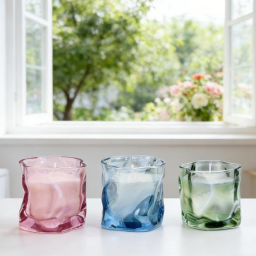
Soy wax, made from hydrogenated soybean oil, is one of the most popular eco-friendly candle ingredients.
Significant advantages:
Renewable resources: Soybeans are crops with a short cultivation cycle, making them a sustainable agricultural product.
Clean combustion: It produces minimal smoke and no black smoke during combustion, and releases almost no harmful chemicals.
Biodegradable: The residual wax can decompose naturally after use, making the container easier to clean and reuse.
Strong fragrance carrying capacity: The low-temperature combustion characteristics enable the essence to be released more evenly and persistently, making it particularly suitable for natural essential oils.
In addition, soy wax is soft and often presents a matte texture, giving candles a rustic and natural aesthetic style that aligns with the contemporary "slow life" and minimalist aesthetic.
III. Beeswax: An Ancient Gift from Nature
Beeswax, secreted by bees and used to build beehives, is one of the oldest candle ingredients used by humans. The ancient Egyptians, medieval monasteries, and even courts relied on beeswax candles for illumination.
Unique value of beeswax:
Purely natural and requiring no processing: it only needs to be filtered and purified, without any chemical modification.
Comes with a honey fragrance: emits a subtle sweet aroma when burned, without the need for additional essence.
Negative ion release: Studies have shown that the combustion of beeswax can release negative ions, which help purify dust and allergens in the air.
Long burning time: High density and high melting point, making it more resistant to burning than soy wax.
Despite its high cost, yellowish hue, and difficulty in dyeing, the purity and eco-friendliness of beeswax make it a representative of high-end eco-friendly candles.
IV. Environmental protection goes beyond "wax": considering the entire life cycle
The true essence of a green candle lies not only in its raw materials, but also in the sustainability of its entire lifecycle:
Cotton or Wood Core: Avoid lead or metal cores, and opt for 100% cotton thread or natural wood cores for safer combustion.
Recyclable containers: Designs for glass jars, ceramic cups, etc. should be conducive to reuse (such as being used as flowerpots or pen holders).
Local production and low-carbon transportation: reducing the carbon footprint of the supply chain.
No synthetic essence and dyes: Plant essential oils and mineral pigments are used to reduce the risk of chemical pollution.
More and more niche brands are embracing this philosophy, adhering to the principles of "zero waste" and "transparent traceability" from raw material procurement to packaging design.
V. How do consumers make green choices?
When faced with a wide range of "environmental candles", consumers can refer to the following points:
Check the ingredient list: Make sure to look for "100% soy wax" or "pure beeswax" and be wary of "mixed wax" that may contain paraffin.
Smell the scent: Natural candles have a gentle fragrance, which is neither pungent nor overly strong.
Observing the combustion state: High-quality eco-friendly candles burn evenly, producing no black smoke or carbon deposits.
Support ethical brands: Give priority to brands that prioritize animal welfare (such as sustainable beekeeping), fair trade, and carbon neutrality.
Conclusion
A single candle, though small, carries profound significance. It serves not merely as a source of light or a carrier of fragrance, but also as a mirror reflecting our relationship with the Earth. Choosing soy wax or beeswax is not merely a product choice; it is a choice that demonstrates respect for nature, cherishes health, and takes responsibility for the future.
As the candlelight flickers, it not only illuminates the room but also reflects the world in our hearts that longs for green and tranquility. In this new trend of environmental protection, every natural candle is a gentle tribute to the Earth.
 Hot News
Aoyin Xingtang Candle Co., Ltd., founded in January 2014, is situated Hebei Province. it features 5 production lines and over 400 machines, specializing in scented candles, tea lights, jar candles, pillar candles, and more.
Fengjiazuo Village West, Yuting Township, Shijiazhuang, Hebei, China
Copyright © Aoyin Xingtang Candle Co., Ltd. All Rights Reserved Privacy Policy
 EN
EN